Bette Smith>Mildred Cameron>Stella Knox>Wm Wallace Knox>Margaret Anderson>Ann Graves>Richard Darling Graves>Mary Wragg>Richard Wragg (my 6th great-grandfather)
One of our ancestors, Richard Wragg, a blacksmith, arrived in Saratoga, New York, scarcely a decade before the American Revolution began. We know he was from Ecclesfield, Yorkshire and married Mary Darling in Yorkshire in 1758. He immigrated with his wife and children to the American colonies in 1768 and from there to Quebec. His story is featured in our family history book.
One piece of information was not included. We now know that there is a good possibility that he was arrested in Yorkshire in 1760 and was sent to the Castle in York to stand trial for High Treason. His crime? Counterfeiting guineas.
Article From The General Evening Post (London) 1760, p 6
Countrynews York May 6
Last week were committed to the Castle, Richard Wragg, of Ecclesfield, Blacksmith, on suspicion of counterfeiting Guineas; and Richard Crabtree and William Pindar on suspicion of counterfeiting Portugal money.
(From Googlebook “The General Evening Post, 1760” accessed Jan 4 2021)
Obviously, Richard wasn’t hanged which was the punishment for High Treason (women were burned to death for the same crime), nor was he transported. However, according to a news article in the Leeds Intelligencer on March 10, 1761 he was still in the Castle awaiting trial which was to take place during the York Lenten Assizes. (Britishnewspaperarchive.co.uk accessed Mar 3, 2021). So what happened? It turns out that this Richard was acquitted even though the evidence was overwhelming.
In the middle years of the eighteenth century there were several spectacular
John Styles, ‘“Our traitorous money makers”: the Yorkshire coiners and the law, 1760-83′, p 10. Final mss. of chapter 5 in John Brewer and John Styles (eds), An Ungovernable People: The English and their law in the seventeenth and eighteenth centuries (London, 1980). Accessed 12 Sep 2021 on https://www.academia.edu/49010097/_Our_traitorous_money_makers_the_Yorkshire_coiners_and_the_law_1760_83
instances of juries acquitting against the evidence in capital coining cases…. Richard Wrag secured an acquittal on a capital indictment at York Lent
assizes in 1761, ‘contrary to the opinion of the judge, who told the jury he hoped they
would not hereafter complain if they received bad money’.
For those interested in the crime of coining, York University has produced a movie (I’m not sure if it was ever released) about a gang which was counterfeiting coins in Yorkshire in the late 1760s. Coining became a huge problem following the collapse of the wool trade and coins were in very short supply. Here is a link to the movie trailer: https://youtu.be/kIA-RUJu4fY as well as back information from the University of York on the movie: https://www.york.ac.uk/news-and-events/news/2009/coin-counterfeiters/
To be continued…
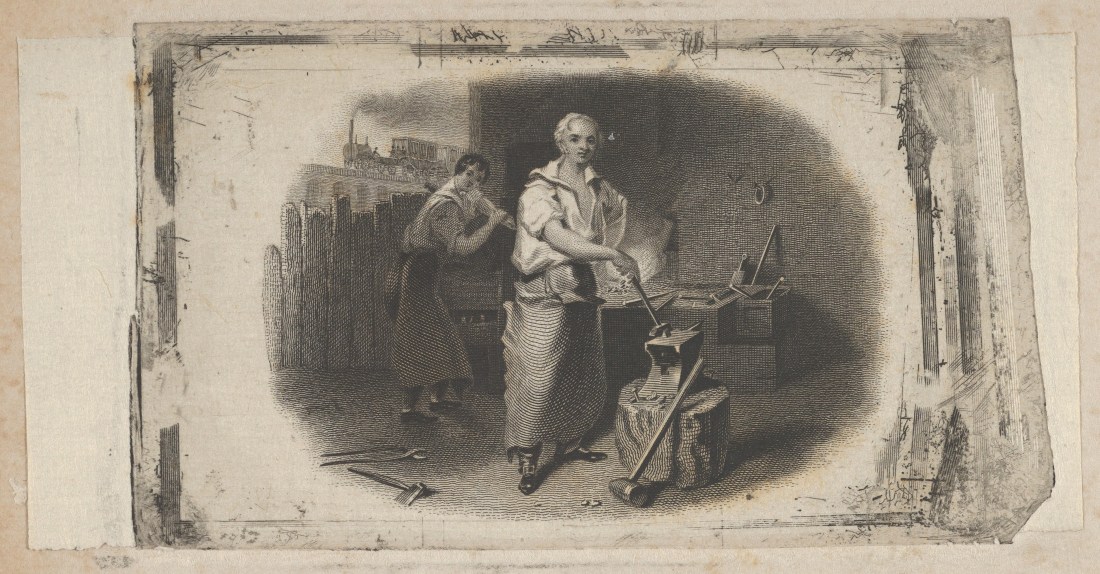
[i] Banknote vignette with a blacksmith and forge, ca. 1824–37 American, Engraving and etching on chine collé; plate: 1 7/8 x 3 1/8 in. (4.7 x 8 cm) sheet: 3 7/16 x 5 1/2 in. (8.8 x 14 cm) (The Metropolitan Museum of Art, New York, Gift of Joseph Veach Noble, 2002 (2002.333.16) http://www.metmuseum.org/Collections/search-the-collections/393945; accessed 18 Feb 2023).

 Tatting the Family Threads...