
Sooo – You are a respectable widow with, we guess, sixty-odd years of good sense behind you and now you are standing on an Aberdeen dock. What would you be thinking if it was the 1830s and you were about to spend five or six weeks crossing the ocean to a land people said was full of trees, wolves and bears? That was the situation facing Ishbal or Isabella Marshall (both names have been found, one in her child’s baptismal record made while she was alive and the second carved years after she had died and had no say in the matter). But whatever her name, she was the widow of William Anderson of Aberdeen and we believe a most respectable woman.
Bette has told about our quest to discover how Isabella Marshall, to use that name for this one blog, is related to us. She presented her argument that the birth year given on the stone was most likely wrong making it probable she was mother to our 3rd-great-grandfather George Anderson and his brother Alexander, and not grandmother as we had originally thought. But even if the stone carver aged her twenty years by pushing back her birth year, she still would have been about 72 or 73 in 1839, the year of her death according to that same stone.
We do not know when she made the journey to the Canadas beyond the obvious—before she died, either in 1839, in accord with the gravemarker, or at the latest in the early 1840s. We also feel it most likely that she made this journey with family. Perhaps she came when her sons George and Alexander left Aberdeen for the Canadas in 1832. At that point, she would probably have been in her mid- to late-sixties. She might also have sailed around 1839 with her widowed daughter Jane and three year old grandson, John Knox. But by then she would probably have been in her early seventies.
As an aside, there is a faint possibility, if we believe the 1911 census entry made in Clarence Township (quite possibly by someone other than John), that the Knox family emigrated in 1850 but there are reasons not to believe it; 1839 is the immigration year given in a second 1911 census entry, this one made across the Ottawa in Lochaber (John managed to be counted twice as he was there temporarily managing a store). It is also the year given in the 1901 census. In addition, we are certain Isabella herself could not have emigrated in 1850 as she was certainly dead by 1847 when her son Alexander died without a will and no spouse or children. For had she been alive, Alexander’s estate would have gone to her, his mother. Instead it was divided among Alexander’s siblings and their children.
We know this ever so-great grandmother of ours had spent part of her life in rural Banffshire but at least three of her adult children lived in the bustling city of Aberdeen. We also have Jane’s marriage record that shows that her father, William Anderson, was alive in 1829. We believe from this that Isabella was a relatively recent widow when she left Scotland.
We will never know why she left home never to return, but we can speculate. Just be cautious reading this blog, for what follows is a string of perhaps and maybes. There is one thing on which we do feel confident. She did not have to go to Canada in order to be cared for by family in her old age. Her oldest son James, his wife Isabella and their children lived in Boharm, Banffshire which, according to google maps, is just a day’s walk away from Aberdeen.
Yet she did not choose this path which should have been both easy and familiar. Perhaps she did not want to live in a house ruled by a daughter-in-law but, more positively, perhaps her decision was taken for reasons completely unrelated to possible family tensions. When George and his family left in 1832, they were embarking on a long and potentially hazardous journey with two small children and with his wife, Elizabeth Philp, likely to give birth on the voyage, as indeed she did. In this scenario, Isabella would have travelled in 1832 to help her daughter-in-law. Sometime after Elizabeth’s 1834 death in Montreal, she went into the Clarence Township bush with George to help with the children, even though he was now probably married to his second wife, our third great grandmother, Ann Graves.
The other scenario, in which Isabella came in 1839, meant that she endured the sea voyage and then immediately brought her young grandson to George in Clarence. Since her daughter Jane is not named on the family tombstone, I think it likely Jane died on the journey or soon after arriving in Quebec. In that case her old mother brought a young child just past the toddler stage up the Ottawa River and then died herself.
In either scenario she could have been driven by the need to help, either Elizabeth with her pregnancy and her two children, or her daughter Jane travelling alone with a small child. If the widow Anderson had a strongly developed sense of duty like our own mother, we can understand her decision. But it is only a guess.
We have surer information about what she experienced during those weeks crossing the ocean. And we are fairly confident that whether it was 1832 or 1839 she was in her sixties. In that time and place she was, with no question in anyone’s mind, an old woman embarking on a life-changing journey.
An Ocean Voyage ca 1832
At this time immigrants still crossed the Atlantic in the holds of sailing ships built for the timber trade. The migrant trade allowed the ship owners to avoid the cost of the “dead head traffic” of sending empty ships across to carry out their real business, importing square cut timber. Many, including quite respectable historians, still repeat horror stories of these passages as told by historian Edwin Guillet in his 1933 work.
Guillet did not make up his tales of horror and suffering, for he took them from contemporary newspaper accounts. The problem is that he tells them as if they were the normal experience. There are no nuances in his history because he did not have access to the sources Lucille Campey used in her books on the Scottish immigrant experience. Campey gives a deeper understanding of how migrants’ made their sailing plans based on a ship’s and, especially its master’s, reputation. Word-of-mouth knowledge could be as good as Facebook reviews for making a decision on which depended not just the cost of the fare but your life. At the same time shipowners wanted masters whose reputation would ensure repeat business for their ships sailing out to North America. They would advertise with this in mind. Bette has found this example of an advertisement in the Aberdeen Journal, June 25, 1834:
FOR QUEBEC The fine fast-sailing Brig SIR WILLIAM WALLACE, Captain Daniel Anderson, Is expected to arrive here [Aberdeen] from Restigouchi [New Brunswick] about the 25th instant [June] and will be despatched for the above Port early in July. The vessel and accommodation are known to be superior; and Captain Anderson’s long experience in the trade, renders this a very desirable opportunity for those intending to emigrate to Canada, at this favourable season of the year. Apply to Donaldson Rose. Aberdeen 9th June 1834
To start with the ships themselves. Guillet characterized them as broken-down and unseaworthy hulks. Yet what sensible businessman entrusts a valuable cargo—timber, that is, not migrants—to an unseaworthy vessel. Campey’s book, Fast Sailing and Copper-Bottomed, examines the insurance ratings of ships owned by Aberdeen owners and sailing out of its port. These were the ships our Andersons were most likely to have sailed on.
Campey finds that those ships which were insured with Lloyd’s of London were rated by Lloyd’s as good to excellent. Some ships were owned by men rich enough to insure themselves but even for these, she gives reasons to believe them built so as to balance the need for speed, abundant cargo space and stability. One company started its timber importing business by buying superannuated whalers, Aberdeen having been a whaling port. But while these ships were superannuated, they were excellent ships to sail on as they were built to ride out the ice and heavy seas of the North Atlantic.
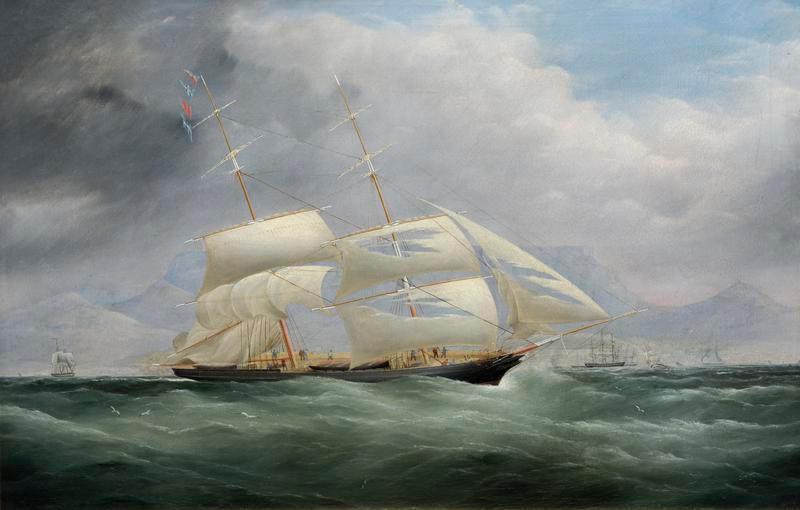
Yes, there were unseaworthy ships in the immigrant trade and this was particularly a problem as the Irish authorities began pushing out as many paupers as possible. Poverty-stricken and sick Irish migrants grew so many in the 1830s, that any ship, seaworthy or unseaworthy, would be brought into the trade. Sometimes these ships were used just for one trip as pushing out as many poor people as possible in one go was the only purpose for which they had been acquired. These ships made up much of the press coverage of the time. But from Campey’s research they were not the norm among the timber ships sailing to and from Scotland. I believe it is fair to say that the Anderson family expected as they went up the gangway that they were entrusting their lives to a strongly built and seaworthy vessel.
What they would not have expected was cruise ship conditions. They would not even have had the conditions of steerage passengers in the steamship trade that began in the 1850s. But they would not have expected such luxury. Crowding in cramped accommodations was commonplace, whether living in an Aberdeen tenement (apartment house) or a Boharm cottage.
Refitting a timber ship into a passenger ship was easy and, as you can guess from the Aberdeen Journal ad, fairly speedy. After unloading the timber cargo in Britain, the shipowner would send in carpenters to lay boards across the crossbeams in the hull. Then they put up sleeping berths against the sidewalls. A few, a very few, ships advertised that they offered six feet of headroom in these quarters but five feet was more usual. The government passed various Passenger Acts between 1803 and 1842 that set standards for headroom as well as how many passengers could be carried based on a ship’s tonnage. But, as no attempt was made to check or enforce, little attempt was made to meet those standards. Campey gives statistics that show even the best ships regularly carried more immigrants than the legislated standard.
Cleanliness was a problem, particularly in bad weather when the hatches were kept closed. There was also the problem of human waste. Donald McKay writes on this in his book about the Irish immigrant experience. His sources are contemporary newspapers, speeches in the British Parliament and the reports of Canada’s emigration agent, A.C. (Alexander) Buchanan. Passengers typically were reluctant to use what to them were flimsy and unsafe toilet facilities. The “heads” were planks with holes which were suspended over the water at either the bow or stern and a rough shed built around it. If you decided against the heads or the weather meant you were locked into the hold, that is where you had to go. If you were lucky, you used one of the few chamber pots kept on board. Otherwise you just found a dark corner . The Scottish ships were not as bad as the Irish immigrant ships but the toilets were the same.
What about the food? Again the Passenger Acts set the standards. So much salt beef, bread, biscuit or oatmeal, molasses and water per immigrant. It was pointed out at the time that very few passengers wanted to eat salt beef, it not being part of their normal diet. Seasickness made salt beef even less appealing. Later the legislation was amended to set a minimum quantity of bread, biscuit and oatmeal. Many migrants, however, from the beginning of these voyages, preferred to bring their own food which they found more palatable and which allowed them to pay a lower fare.
Water? That everyone agreed was bad, including Campey based on contemporary diaries. The problem lay in what the casks had held previously and whether the ship’s crew had put any elbow effort into cleaning them before putting in water. Then the water got even worse as it sat for five to six weeks in the casks on deck during the voyage. Some travellers added vinegar to make it drinkable but, to go by Alexander Muir’s 1845 diary, it did not help. Muir was an Aberdeen lawyer who came to Canada to visit relatives, including his sister in our own Cumberland, Ontario. He wrote that he was never seasick but had no appetite for either meat or drink. He singled out the water as something not to be faced. It had been stored in molasses casks and became so bad it was impossible to disguise its taste.
No-one expected luxury. However, if care was taken to check the reputation of the ship and its master, then migrants could reasonably expect a normal trip of the usual five weeks or so, safe from sinking, safe from food running out, and safe from disease. There could always, of course, be bad luck.
Only four months after the confident Aberdeen Journal ad, the Sir William Wallace returning from Quebec under Captain Anderson was driven by a gale onto an island in the Hebrides. The first report suggested the ship and all on it was saved but a week later a fuller report laid out the full danger the crew had run. Captain Anderson had managed to bring the ship into a bay when it became clear they could not tack clear of the shore. The next morning, however, the gale broke the main anchor and was driving the ship onto the rocks. The captain and crew then slipped the two remaining anchors such that they could manoeuvre the ship into a safer position despite the sea incessantly crashing over the ship. Nevertheless, their provisions were entirely lost and the men became exhausted with the fight while the gale was too fierce for the people on shore to help. The captain then had a cask with a rope attached thrown from the ship. When it drifted to the shore the inhabitants made it fast. A seaman then worked his way down the rope after which they were able to warp one of the ship’s boats to shore with the rest of the crew. Yet even though the newspaper reported that the Sir William Wallace was wrecked, having lost most of her keel on the rocks, no-one died and the cargo was saved. (Aberdeen Journal, November 5, and November 12, 1834). And so, a good master might very well have made a difference.
All the Andersons would have experienced a long hard month travelling to Canada whether you were George’s pregnant wife Elizabeth Philp in 1832, or the men George and Alexander Anderson, or a young child such as John Knox was in 1839. How would an old woman, as Isabella Anderson would have been called in her time, have dealt with the shipboard conditions of bad water, iffy food and living in close quarters in the hull of a ship with seasick fellow passengers, even if you were not horribly sick yourself? Not to mention the toilets!
Let me take a straw poll at this time. Who among you, whether over 60 now or knowing you will be 60 someday, would have gone up that gangplank as our fourth great grandmother did in the 1830s, possibly for no other reason than to see to safety in Canada children and grandchildren?
Dorothy J. Smith
Sources
Estuary of the Dee, Aberdeen (1838), Watercolour on Paper by Joseph William Allen (1803-1852). Aberdeen Archives, Gallery & Museums has released the image which is an out of copyright work, Object Number ABDAG001225, into the public domain under the Creative Commons 0 license (CC0). (https://emuseum.aberdeencity.gov.uk/)
Old Parish Registers Births, Boharm, 1802 (National Records of Scotland).
Aberdeen, St. Nicholas kirk session, Minutes, 1829 (National Records of Scotland).
Scotland Census, 1851 (National Records of Scotland).
Census of Canada, 1901 and 1911 (Library and Archives Canada).
Aberdeen Journal (newspapers.com).
The Brig “Isabella Leith” of Aberdeen (1850), Oil on Canvas, Artist unknown. Aberdeen Archives, Gallery & Museums has released the image, which is an out of copyright work, Object Number ABDAG008039, into the public domain under the Creative Commons 0 license (CC0). (https://emuseum.aberdeencity.gov.uk/)
From Aberdeen to Ottawa in 1845: The Diary of Alexander Muir, ed. George A. MacKenzie.
Lucille H. Campey, Fast Sailing and Copper-Bottomed: Aberdeen Sailing Ships and the Emigrant Scots They Carried to Canada, 1774-1855.
Edwin C. Guillet, The Great Migration: The Atlantic Crossing by Sailing-ship Since 1770.
Donald MacKay, Flight from Famine: The Coming of the Irish to Canada.

 Tatting the Family Threads...
Loved your story! Well researched and well written.
LikeLike
Yesterday Dani and I went to Stratford for lunch with cousins Georgina & Candace. I fretted about a 45 minute journey, so would I take off from Aberdeen to Canada? Not on your booties! And if I had to leave my pets behind, that would never happen. Here I stay, I will do no other! Ha Ha.
LikeLike
I was seasick once crossing the English channel in a hovercraft. I was so sick I had no awareness of what was going on around me, not even noticing when my friend was moved to a different seat and a stewardess sat down in her place. Clearly if had gone I would have been worse than useless. I would have been the person needing care.
LikeLiked by 1 person
I have a feeling I would have gone. What a very interesting read!
LikeLike