Ominous News and Worrying Rumours
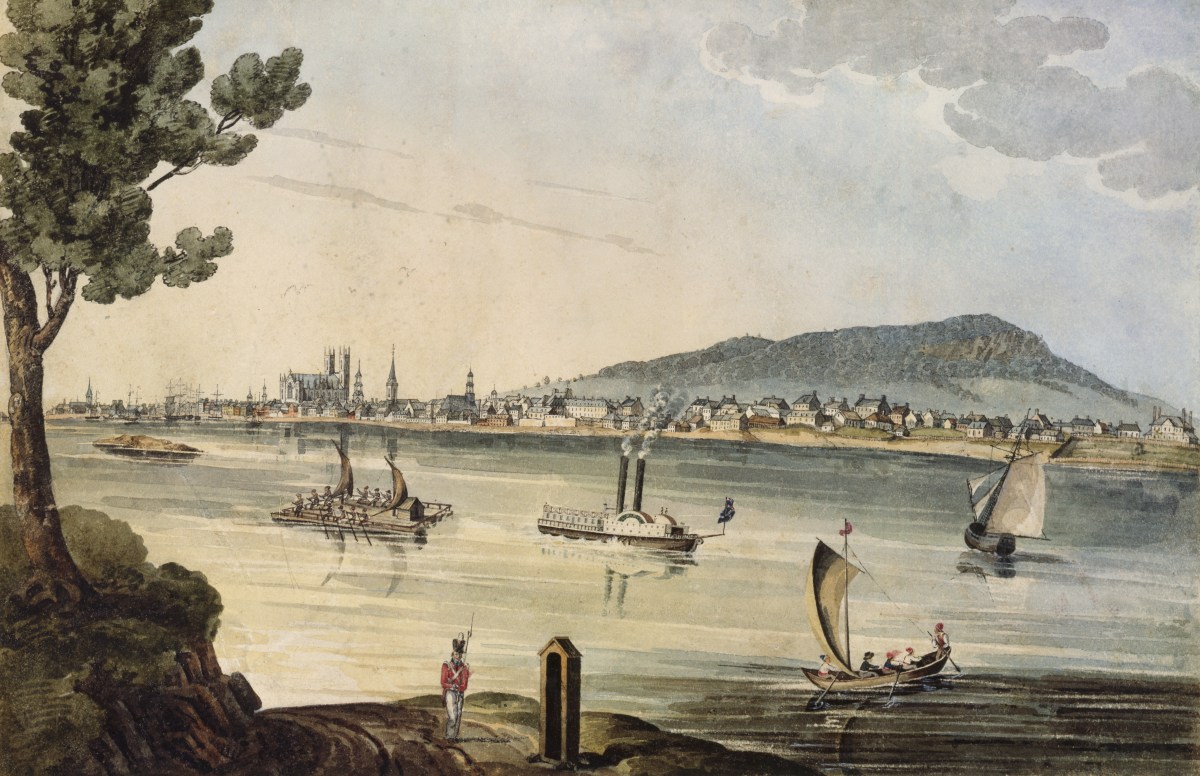
The Quebec newspapers and provincial authorities had been following the progress of the Asiatic Cholera epidemic for some time as it moved from the Ganges in India through Europe and finally to Great Britain in the autumn of 1831. Some people reacted with panic. Others felt that the worries were overblown and were unnecessarily restricting business while simply fueling panic. Very little was known how cholera spread and treatments (such as firing canons to clear the air) were even less useful. The only effective option was to stop the disease from entering the country, or if it did arrive, to contain it.
The provincial authorities took several important measures in February 1832 to prepare for the worst. They established a quarantine area at Grosse Île, a few miles from Quebec City, to screen ships and emigrants and they established a Board of Health to provide oversight and enforcement of a long list of public health regulations. Unfortunately, the few persons charged to oversee the quarantine of ships and enforcement of public health restrictions were soon overwhelmed by the heavy river traffic as thousands of emigrants began to arrive in May, following the breakup of the ice on the St Lawrence.
A Contentious By-election
Fraying tempers were not helped by the arrival of more emigrants. Emigration had been a contentious topic in Quebec for years. French Canadians believed that the British Government was sending their surplus population to supplant French culture and that these same emigrants were to blame for bringing with them disease and death. It is certainly true that the English-Scottish population in Quebec increased dramatically with waves of emigration starting in the 1820s. At the same time, most French Canadians were excluded from positions of power or patronage and had little say over the governance of their province.
By 1832 there were two major political parties in Quebec vying for seats in the Legislative Assembly. The Patriote Party, which was strongly opposed to British emigrants, was led by Louis-Joseph Papineau while the English (or Tory) party was formed by persons who were, by and large, businessmen or members of the ruling class who controlled the Legislative Council. An 1832 by-election in Montreal’s West Ward led to violence, although the causes, events and outcome are not without controversy.[ii] Briefly (and without trying to ascertain the historic truth of what happened), a by-election was held in the Spring of 1832. The election began April 25 with the polling place located at Place d’Armes. The English (Tory) party candidate, Stanley Bagg, was supported mainly by businessmen of English, Scottish and American origin. This was Bagg’s first foray into politics and he was a merchant who had been born in the United States but had moved to Canada with his family in 1795 about the age of seven. Overall, he was considered to be a decent and fair man. He was opposed by the Patriote’s candidate, Daniel Tracey, a medical doctor from Ireland, as well as a journalist/founder of The Vindicator and a bitter opponent of the ruling elites. Voting was public (no secret ballot) with several altercations taking place between supporters of the two parties over 22 days. As well, bully-boys were hired (mostly by Bagg’s supporters) to discourage the other side from voting by means of intimidation or physical assaults. The special constables who were supposed to keep the peace were mainly active supporters themselves of Stanley Bagg[iii] and some were the same bully-boys hired by Bagg supporters. Politics in early Canada was very rough and tumble.
As an interesting aside, women who owned property in their own name could vote. One of those was Ann Wragg, widow of John Platt (and Great Aunt to Ann “Nancy” Graves):
La veuve Ann Platt, active dans le marché immobilier montréalais, possédait deux propriétés le long des principales voies publiques, les rues Notre-Dame et Saint-Paul, dans l’ouest de la vieille ville; la valeur annuelle de ces propriétés s’élevait à environ 180 £. Les veuves Oakes et Platt votèrent toutes deux pour le candidat de l’ordre établi, Stanley Bagg.[iv]
On May 21, Tracey narrowly took the lead and fighting broke out with people using sticks, stones and, yes, even umbrellas as weapons. It is claimed that a magistrate (reports differ as to this person’s identity), alarmed by the altercation, read the Riot Act and called out the army from the local garrison. It is also a matter of contention as to whether the officer in charge, Lieutenant-Colonel A.F. Macintosh, gave any warning before his soldiers fired directly into the crowd. Three people—Casimir Chauvin, Pierre Billet and François Languedoc—were killed and several more injured. The three men who were killed were not involved in the altercation, but were simply in the area on their way to or from work. The day following the May 21 event, Tracey was declared the victor of the election by four votes.[v]

The Patriotes believed Macintosh and Captain Temple who served under him had committed murder. What quickly followed was a coroner’s jury with a split vote. Of the twelve jurors, nine believed the military had fired on people who were already dispersing the area. Three agreed that the military had fired on the crowd but said that the orders had been given in response to an ongoing riot. In response to the split vote, the coroner had charges of murder brought against Macintosh and Temple and then adjourned the jury until August 27.
Cholera Arrives in Lower Canada
Following the Spring arrival of emigrant ships, rumours began to circulate that cholera was present at the Quebec City Emigrant Hospital. The head of the Legislative Council, Lord Aylmer, declared May 4 to be a day of fasting and humiliation in order to beseech “God to avert from Us that grievous disease….”[vii] The first instances of cholera aboard ships were recorded at the end of April although this information was not published. At first the authorities denied that cholera was present in the cities. On June 8, Quebec City officials acknowledged the presence of cholera in the city and by June 10 it was also present in Montreal.[viii]
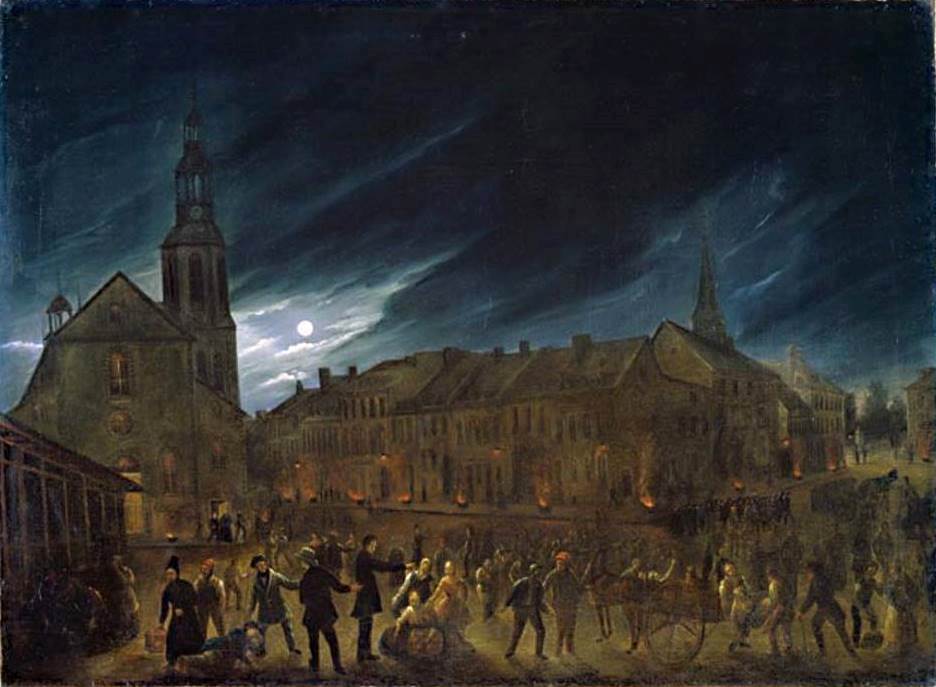
The painting “Cholera Plague, Quebec” by Joseph Légaré depicts the grim arrival of cholera in Quebec City. The colours are dark and foreboding. A man has fallen in the street, while elsewhere bodies are being brought out to a cart. There was indeed panic at first, but over time the people of Quebec became accustomed to the presence of cholera.
Planning in Montreal for the disease lagged far behind Quebec City. No arrangements had been made to provide hospital care for the victims, and when the disease did arrive, the Board of Health took the sheds intended to house newly arrived emigrants and used these instead for the cholera victims. Many Quebecers, especially the “Canadiens”, blamed emigrants for bringing cholera to their province and did not want the cholera sheds located in their neighbourhoods. Sounds alarmingly familiar, doesn’t it? Just as thousands of emigrants were pouring into Montreal, residents refused to provide them with accommodation or other amenities.[x]
The action of the Montreal Board was a direct consequence of their failure to provide hospital space before the epidemic began. With cholera in the town, the Board could offer the victims only the sheds, one without a floor, where the patients lay on straw “exposed indiscriminately to the open windows and doors – men, women and children; the convalescent, dying and the dead laid in an irregular line along the sides of the building.” The Montreal General Hospital continued to refuse to admit cholera patients, or even to erect a shed for them on its grounds, and the Board was forced to build a second cholera hospital, a rough shed on the Rue St. Denis. One paper said that the Montreal hospitals “might be more properly called dying houses than hospitals.” Not until late June was a doctor appointed as a non-resident, part-time, supervisor and the minimum equipment and supplies made available for the hospitals.[xi]
One of the victims of the epidemic was Dr. Daniel Tracey who had been tending the sick when he contracted the disease. He died July 18 at the age of 38 years without ever taking up his newly-won seat in the Assembly.
Susanna Moodie travelled through Montreal in September 1832 on her way to Upper Canada and wrote about her impressions:
In the morning we were obliged to visit the city to make the necessary arrangements for our upward journey.
The day was intensely hot. A bank of thunderclouds lowered heavily above the mountain, and the close, dusty streets were silent, and nearly deserted. Here and there might be seen a group of anxious-looking, care-worn, sickly emigrants, seated against a wall among their packages, and sadly ruminating upon their future prospects.
The sullen toll of the death-bell, the exposure of ready-made coffins in the undertakers’ windows, and the oft-recurring notice placarded on the walls, of funerals furnished at such and such a place, at cheapest rate and shortest notice, painfully reminded us, at every turning of the street, that death was everywhere—perhaps lurking in our very path; we felt no desire to examine the beauties of the place. With this ominous feeling pervading our minds, public buildings possessed few attractions, and we determined to make our stay as short as possible.[xii]
The Montreal Board of Health issued regulations intended to clean up the filthy garbage-filled streets, all of which lacked sewers. On June 12 The Montreal Gazette[xiii] published regulations regarding cleanliness. These included: (1) dirty water, vegetables, ashes, soot, filth or dirt of any kind was not to be thrown into the streets; (2) Hogs were not to be kept in dwelling houses within the city, suburbs or port of Montreal or to be allowed to wander in the streets; (3) Dead animals were to be removed from the streets and buried at least three feet below the ground surface; (4) Anyone who had died from cholera was to be buried within six hours or, if at night, within twelve hours. Funerals were not permitted.
Their edicts were largely ignored. Since no one knew at that time what caused cholera, the residents did not link it to contaminated drinking water or food. Many thought it was transmitted in the miasma (the noxious air that they breathed). William Wragg himself was convicted of having allowed dirty water and garbage to flow from his yard into the street. He was fined five pounds.[xiv]
The City’s efforts proved ineffective and it is estimated that around 2,000 Montrealers died of cholera between June and September.[xv] With a population of 27,000 this would mean that approximately 13-15% died from cholera in just four months, although I do not know how many of these were newly-arrived emigrants. Our family was not to be spared. William and Sophia’s only daughter, Amelia Sophia, died of cholera on September 12, 1832 at the age of six years and ten months.[xvi] She was buried the next day in the family plot at the St-Lawrence Cemetery and in accord with health regulations there was no funeral and the family was not allowed to be present.[xvii] William and Sophia were left with only one child, their son—Thomas Robert—who had been born one year earlier.
We have to wonder just where George Anderson, his wife Elizabeth Philp, mother Isabella Marshall (if she emigrated with them) and three children, one a new-born, stayed when they arrived by ship in 1832. The Andersons had followed their Aberdeen minister, the Rev. John Gilmour, to Canada. Gilmour had taken up his call as pastor of First Baptist Church in Montreal in 1831. Either Gilmour or other members of the congregation may have assisted our Aberdeen ancestors to find suitable accommodation. It is also possible that the Andersons stayed with a Wragg or Graves Loyalist family when they arrived in Montreal, this being one of our family’s stories. Certainly Ann Wragg Platt had significant rental properties in Montreal and may have made rooms available to the Andersons.
Deaths from cholera began to subside in September and officials declared the epidemic over in November.
The Events of May 21 Continue to Cause Trouble
On August 27, the Criminal Court of King’s Bench opened. The coroner said it was problematic for the coroner’s jury that had served in May to consider the evidence, as few of the original jurors were available and they had been unable to come to a unanimous verdict in the first sitting. Instead, it was decided, a grand jury would investigate. This jury was put together by the Sherriff and many believed it was packed to obtain a verdict of “not guilty”. William Wragg (Nancy’s Great Uncle) was one of the men selected to serve on the Grand Jury, almost all of whom were of British heritage. Editorials published in The Vindicator made much of the fact that very few of the jurors were French Canadian.
By September 2 the Grand Jury considering the charges against Lt.Col. Macintosh and Captain Temple exonerated them. A second warrant accusing Macintosh and Temple of murder was brought forward mid-September but was not allowed to be executed. The Patriote Party under Papineau then pushed for an official inquiry which was held in the Legislative Assembly between December 1832 and March 1833. A printed record of the proceedings was deposited in the Journals of the House of Assembly of the Province of Lower-Canada. In the end, most minds did not change. Those supporting the English Party believed a major rebellion had been averted while those aligned with the Patriotes felt there had been a massive cover up.
The Year comes to an End
As we learn more about our ancestors, we can see their entire lives played out against the events of the past. Like omniscient narrators, we know what happens next. But take a moment and place yourself and your own family members in their midst.
Imagine the intense feelings as the church bells begin to ring out, heralding a New Year. There is deep sadness, yes, as you remember family and friends lost in the epidemic. But perhaps a feeling of joy too as you greet loved ones. And lastly, what a sense of relief there must be to know 1832 has finally ended!
[i] Sproule, Robert Auchmuty, “Montreal from St Helen’s Island”, 1830, Object Number M301, McCord-Stewart Museum. Watercolour, ink, opaque white and graphite on paper (https://collections.musee-mccord-stewart.ca/en/objects/11401/montreal-from-st-helens-island Object M301: accessed 3 Aug 2022).
[ii] Enquête devant la Chambre d’assemblée du Bas-Canada sur les événements du 21 mai 1832 […], Québec (Province), s.n., 1833, 1 ressource en ligne (2 vol. (204, 126 p.)), Collections de BAnQ. (https://numerique.banq.qc.ca/patrimoine/details/52327/3254841: accessed 25 Jun 2022).
[iii] One of the special constables was Thomas Busby Wragg, William Wragg’s nephew and Nancy Graves’s cousin. He was “sworn to maintain the Peace in the vicinity of and near the hustings, for the West Ward of the City of Montreal”on 27 Apr and, if I read the information correctly, he voted for Bagg on 3 May. Cf. Enquête devant la Chambre… (digital image 308 of 516).
[iv] Bradbury, Bettina, “Veuves et électrices: genre, citoyenneté et élection partielle à Montréal en 1832”, p. 30 (Translated by Hélène Paré). Original English version “Widows at the Hustings: Gender, Citizenship, and the Montreal By-Election of 1832”, Rudolph M. Bell et Virginia Yans, (eds.), Women on their Own: Interdisciplinary Perspectives on Being Single, Rutgers, 2008, p. 82-114.
[v] Jackson, James, The Riot that Never Was: The Military Shooting of Three Montrealers in 1832 and the Official Cover-up (Montreal: Baraka Books, 2009), 360 pp. Most of the material in my story concerning the events and aftermath of the May 21 altercation is taken from Jackson’s book. The author contends that there was no riot but that the grievances raised during the by-election as well as its aftermath were part of the buildup to the 1837 Rebellion. It is also clear from reading his book (and even from reading the title) that the author is biased and Jackson is well aware of his bias but stands by his arguments.
[vi] Viger, J. [Jacques] and Wyld, James, Plan of Place d’Armes and St. James Street at Montreal for the elucidation of the events of the 21st May, 1832 (Montreal, s.n. 1832?). (https://collections.banq.qc.ca/ark:/52327/2244528Q: accessed 3 Aug 2022).
[vii] “Proclamation”, The Quebec Gazette published by authority/Gazette de Québec publiée par autorité, 19 Apr 1832, p. 4 (Collections de BAnQ, https://numerique.banq.qc.ca/patrimoine/details/52327/4370113?docpos=4: accessed 4 Aug 2022).
[viii] “Cholera: Canada’s 19th-Century Terror”, The French Canadian Genealogist (http://www.tfcg.ca/history-of-cholera-canada: accessed 3 Aug 2022).
[ix] Légaré, Joseph, “Cholera Plague, Quebec”, c. 1832, Assession Number 7157, National Gallery of Canada. Painting, oil on canvas. (https://commons.wikimedia.org/wiki/File:Le_cholera_a_Quebec_en_1832_-_Joseph_Legare.jpg: accessed 4 Aug 2022).
[x] Bilson, Geoffrey, “The First Epidemic of Asiatic Cholera in Lower Canada, 1832”, Medical History, 1977, 21:411-433, (Cambridge University Press, https://www.cambridge.org: accessed 25 Jun 2022).
[xi] Op.Cit., p. 421.
[xii] Moodie, Susanna, Roughing it in the Bush, excerpt from Ch 2—Quebec (Richard Bentley, Publisher, 1854, 3rd edition). (Project Gutenberg e-book,August 2003 and updated 16 Mar 2018, https://www.gutenberg.org/files/4389/4389-h/4389-h.htm#link2H_INTR: accessed 4 Aug 2022).
[xiii] “Rules and Regulations, Orders and Directions, Made and Established by the Board of Health in and for the City, Port, and Harbour of Montreal”, Montreal Gazette, 12 Jun 1832, p 3 (www.newspapers.com: accessed 3 Aug 2022).
[xiv] William Wragg’s ₤5 fine would be equivalent in 1832 England to 25 days wages for a skilled workman, so not an insubstantial sum (https://www.nationalarchives.gov.uk/currency-converter/#currency-result: accessed 24 Jun 2022).
[xv] Sendzik, Walter “The 1832 Montreal Cholera Epidemic: A Study in State Formation” (M.A. thesis, McGill University, Montreal, 1997) 2. Sendzik notes that the “final number of dead in Montreal has been listed as 1904, but it has been speculated that number is above 2000 as many cases may have gone unreported…. The statistics for cholera deaths were taken from Digest Records Issued by the Board of Health of Montreal, Montreal Gazette 10 September, 1832.” (https://www.collectionscanada.gc.ca/obj/s4/f2/dsk2/ftp01/MQ37236.pdf: accessed 3 Aug 2022).
[xvi] “Montreal Deaths”, Quebec Mercury, Sat., 15 Sep 1832, p. 2. “On Thursday of cholera, Amelia Sophia, only daughter of Mr. William Wragg, aged six years and ten months.” (https://numerique.banq.qc.ca/patrimoine/details/52327/3662943?docpos=2: accessed 4 Aug 2022).
[xvii] Drouin Collection, Christ Church Anglican Cathedral, 13 Sep 1832, Folio 101A (www.Ancestry.ca: accessed 25 Jun 2022). For the many burials recorded both before and after Amelia’s, there are only three signatures: the presiding minister and the same two witnesses in every case. Previous to the epidemic at least one witness would normally have been a family member.


 Tatting the Family Threads...

How interesting that while our understanding of disease has evolved, our basic and regrettable human response to it has not.
LikeLike
Yes, indeedy! I definitely had that feeling as I researched this blog.
LikeLike