Bette > Mildred Cameron > Harvey Cameron > Harvey’s nephew Alfred Cameron, the son of Harvey’s brother John Alexander Cameron.
In My Beginning Is My End
Our cousin, Claribel Cameron Beba, was ahead of her time in her understanding of the long-term health risk caused by ticks, which are part of the arachnid family. So it was that in October 1936, she wrote to her Aunt Stella Cameron to inform her of the death of Claribel’s brother, Alfred.
Alfred had the finest medical attention but his system seemed entirely “shot”. I feel it is the result of the rotten climatic conditions in Mozambique, his first African post. While there he had a tick bite and the poisons he had to take to counteract the fevers etc. must have laid the foundation for his break down. The doctors could not understand why a man of his age should be in such bad shape as he was a person of good habits…. But that is all past now and we shall have to resign ourselves to the inevitableness of life.[i]
Alfred was a man who seemed to be in good physical condition, so his sudden decline and death at the age of 42 years was a shock to his family. Was his premature death the result of a tick bite as Claribel suggested?
Thirteen years before, Alfred was described on his passport[ii] as being 6 foot, 1 inch in height, with grey eyes and brown hair. His passport photo shows a young man with a strong jawline and a dimpled chin. His handsome features could easily rival those of then current matinee idols Clark Gable and Cary Grant. This gave him an advantage in life, but he also appears to have made good use of opportunities which took him from comparatively inauspicious beginnings to serving as American Consul in various countries.
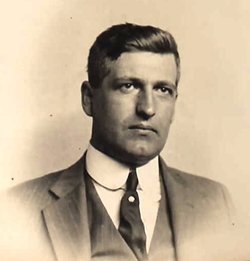
Alfred’s Early Years
Alfred was born in Seattle, Washington on November 3, 1893, the first-born child of John Alexander Cameron and Catherine “Kate” Zulma Hagener.[iii] Alfred’s father left the family sometime before 1910 to pursue work as a miner in Alaska. The Seattle family remained in contact with John Alexander, as well as with his brothers’ families in Canada.
In 1910, his mother Kate was listed on the census[iv] as the head of household, widowed, working as a piano teacher and, together with her three children–Alfred, Eda May and Claribel Rose–was living on Pontius Avenue in the Cascade neighborhood abutting downtown Seattle. Alfred’s father was listed on a 1910 Alaska census[v] where his marital status was given as divorced.
School Days
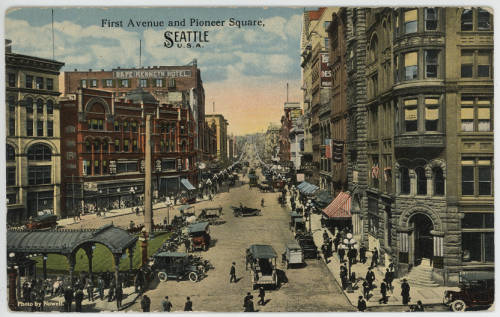
Alfred’s first education was undertaken at the primary school in his home neighbourhood, an area of working family homes and small farms.[vi] In 1906, Alfred moved from the Cascade School to Broadway High School in downtown Seattle which had recently opened and which broadened his cultural experience. “Broadway High was a remarkably busy place, and distinguished for its mix of classes and races.”[vii]
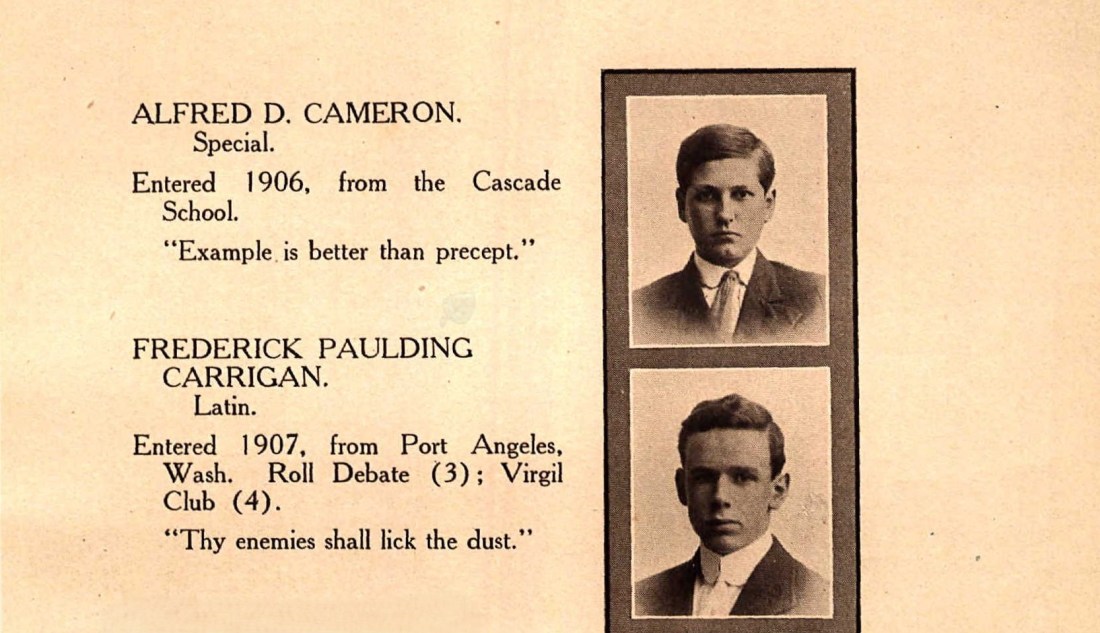
According to his 1910 yearbook,[viii] Alfred’s course of studies was categorized as ‘Special’. I have no idea what this category entailed. His yearbook entry included the photograph of a serious young man. Both his demeanour and the accompanying maxim “Example is better than precept” were in keeping with similar entries of his classmates.[ix] There is no indication that Alfred was involved in any extra-curricular activities such as those listed for other graduates—activities such as Roll Debate, Virgil Club, Greek Club, etc. The 1910 census gave Alfred’s occupation, aged 16, as ‘library page’ so his work may well have taken up any extra-curricular time.
After high school, Alfred attended the University of Washington State. I have found no indication that he graduated with a degree, although this was not unusual for the time. Alfred was listed as a Liberal Arts Freshman for the 1913-1914 academic year.[x] His 1917 army enlistment record states that he served as a U of W cadet from 1913 to 1914 and that he was an “insurance solicitor” prior to entering the army[xi] While he enlisted in the Washington State National Guard in 1916, he was not called up to active duty. His active national service really began with the United States’ entry into World War I.
The Mexican Border and the Zimmermann Telegram
The border between the United States and Mexico has been contentious since the 1846 Mexican-American War in which the United States annexed Mexican territory, now part of Texas, New Mexico, and Arizona. By the turn of the twentieth century, Americans were more concerned about violence on their southern border than conflicts in faraway Europe. They were certainly right to be alarmed.
The Mexican Revolution of 1910-1917 involved continuous fighting between the Mexican Government and rebel leaders (also called “bandits”) such as Francisco “Pancho” Villa, Governor of Chihauhua. This fighting gave rise to an unstable situation at the international border. U.S. President Woodrow Wilson made the decision to back the Mexican government led by Venustiano Carranza, which ultimately enabled Carranza’s defeat of Pancho Villa. In retribution for US involvement, Villa began attacks on American targets in New Mexico and Texas in Spring 1916.[xii]
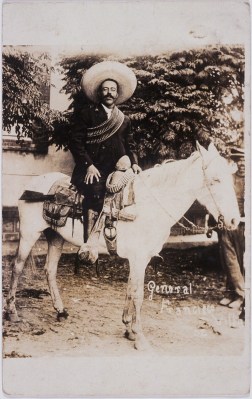
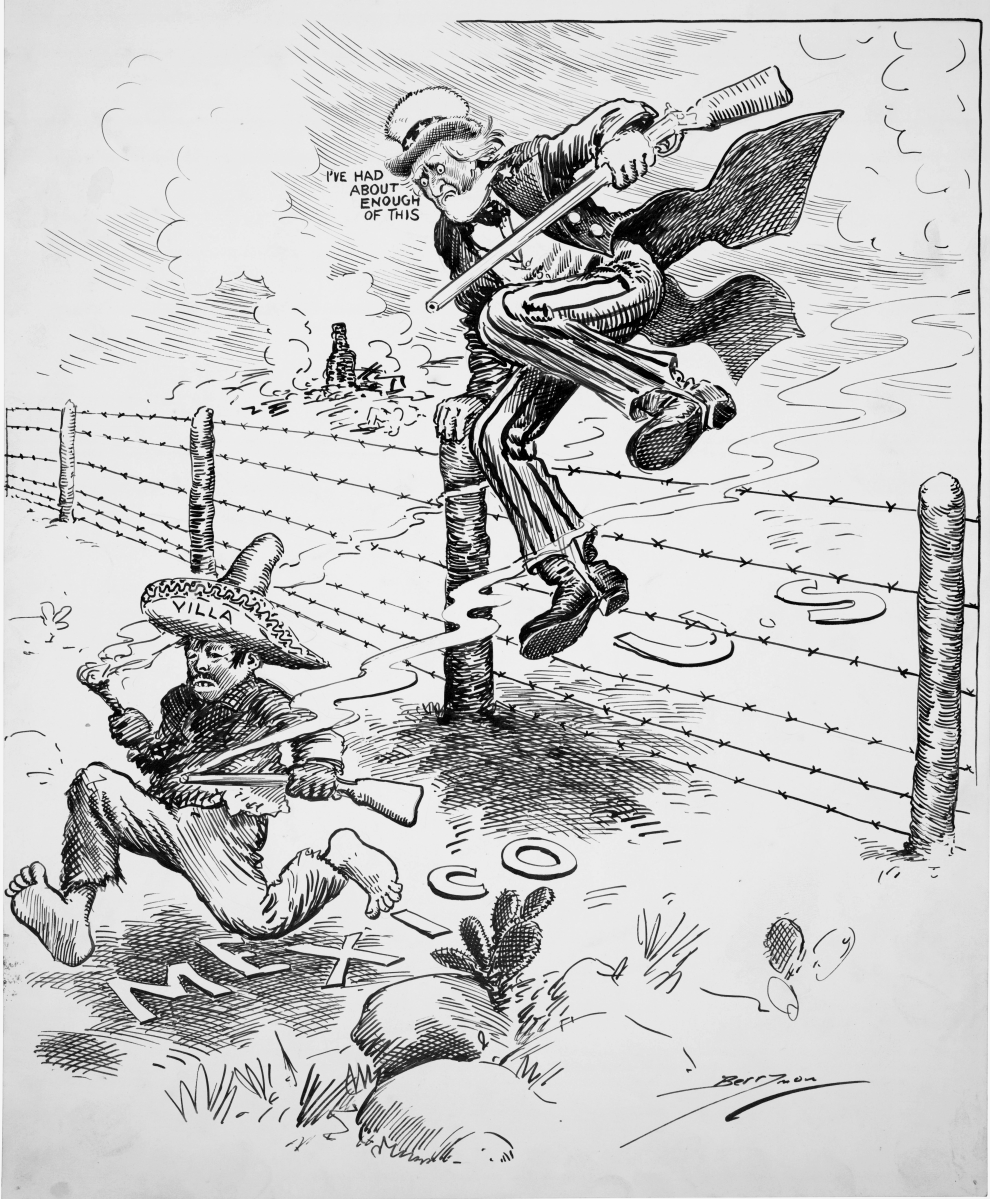
Wilson authorized the military to send a Punitive Expedition into Mexico to capture Villa. Initially, the Mexican government gave begrudging permission and support for the Expedition’s military presence in Mexico but limited American military action to the state of Chihauhau. Later, troops from the Mexican National Army made scattered attacks on U.S. forces. While the Americans were not successful in capturing Villa, they began withdrawal from Mexico in February 1917 and claimed the Expedition to be a success. Unfortunately, tensions between Mexico and the United States were by then at an all time high.[xv]
Tensions between Mexico and the United States did not go unnoticed by Germany. Europe had been engulfed in war since the summer of 1914. The United Kingdom, together with Commonwealth nations declared war on the German empire in August 1914. Initially, the United States remained neutral as Americans were strongly opposed to becoming embroiled in a European war. Popular opinion began to change as newspapers reported on atrocities committed by the Germans, such as the 1915 sinking of RMS (Royal Mail Ship) Lusitania with a loss of 1,198 passengers, including 128 Americans.
The final straw was the revelation of a coded telegram sent in January 1917 by German Foreign Secretary Arthur Zimmermann to the German minister to Mexico.[xvi]
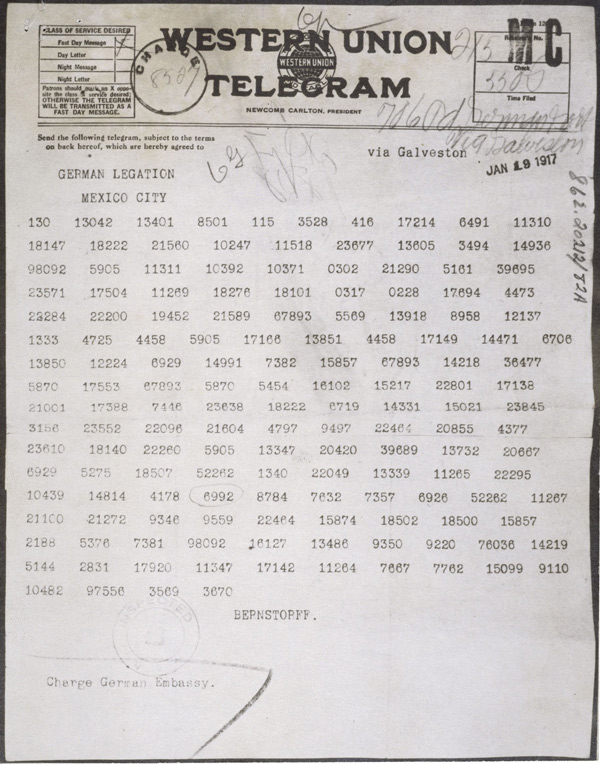
The telegram was intercepted by British Intelligence, the code was cracked, and the contents of the telegram translated and shared with Washington. It was then published in U.S. newspapers on March 1.
The translation reads as follows:
We intend to begin on the first of February unrestricted submarine warfare. We shall endeavor in spite of this to keep the United States of America neutral. In the event of this not succeeding, we make Mexico a proposal of alliance on the following basis: make war together, make peace together, generous financial support and an understanding on our part that Mexico is to reconquer the lost territory in Texas, New Mexico, and Arizona. The settlement in detail is left to you. You will inform the President of the above most secretly as soon as the outbreak of war with the United States of America is certain and add the suggestion that he should, on his own initiative, invite Japan to immediate adherence and at the same time mediate between Japan and ourselves. Please call the President’s attention to the fact that the ruthless employment of our submarines now offers the prospect of compelling England in a few months to make peace. Signed, ZIMMERMANN.[xvii]
Not surprisingly, the United States declared war on the German Empire on April 3, 1917.
Alfred was called up to active duty as a Private 1st Class in March 1917 at the age of 24 years and transferred from the National Guard to the U.S. Army in November of the same year. Unlike many American soldiers, he was not sent to fight in Europe. Instead, he was sent to the Mexican border.
My guess is that Alfred had an aptitude for leadership, organization, and logistics. During the period 1916 to 1920, Alfred was promoted from Private 1st Class to 2nd Lieutenant. Following the war, he remained in the army and was posted to Noboken, New Jersey, Camp [later Fort] Dix, New Jersey, and then sent to Europe. He was assigned to the Transportation Service of the American Occupational Army in Cologne, Germany. He remained in the Army until 1922, resigning with the rank of Captain.
American Wives Preferred
The 1920 census shows Alfred in Cologne, Germany living with his wife, Cecile Eugenie Clement. Her background is a bit confusing as information from official documents do not always agree. Records are consistent in reporting that Cecile was six years older than Alfred. Her place of birth, France, remained consistent. However, it remains unclear as to when and where she met and married Alfred, whether she was single or widowed at the time of her marriage, the names of her parents, or indeed, her surname prior to her marriage.
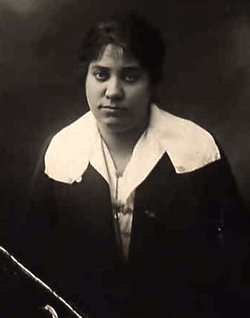
Her 1923 passport describes Cecile as being 5 foot 3 inches in height with blue eyes and brown hair.[xviii] Alfred’s sister Claribel made the claim that Cecile was a Countess. I have found nothing to prove or disprove this information. Cecile, to some extent, remains an enigma.
In 1923, Alfred joined the Foreign Service and served as Vice-Consul in Marseilles, Lille, and then as Consul in Paris, France. One might think that Alfred’s choice of a French bride would be helpful in promoting his career, but this may not be the case.
The American Ambassador to France (1936-1940), William C. Bullitt, believed that the American embassy ought to be represented by American women. Prior to World War II he used his influence with President Franklin Roosevelt “to encourage a rule requiring FSO’s to submit their resignation and formally request permission to marry foreign spouses. Many people felt that marrying foreign wives took away from American diplomacy and created un-American homes and embassies.”[xix]
Interviews with American diplomatic personnel on the issue of foreign-born spouses underscored the existing tensions between American and foreign-born wives. Margaret Jones Palmer served in Germany as a receptionist and visa clerk from 1938 to 1939 and was interviewed in 1992:
One thing that struck me when I first arrived in Hamburg – and this is absolutely nothing against foreign wives, either, they are just wonderful and contributed an awful lot to our Service – but in the huge Consulate General there was only one American wife, which I found amazing…
We went to every single reception, you were wined and dined and taken care of. But there was, to my way of thinking, a Polish household, a Swedish household, a French household, a Latvian household, and all the men were very American. But at home, those weren’t American homes.[xx]
Life as a Consular Officer
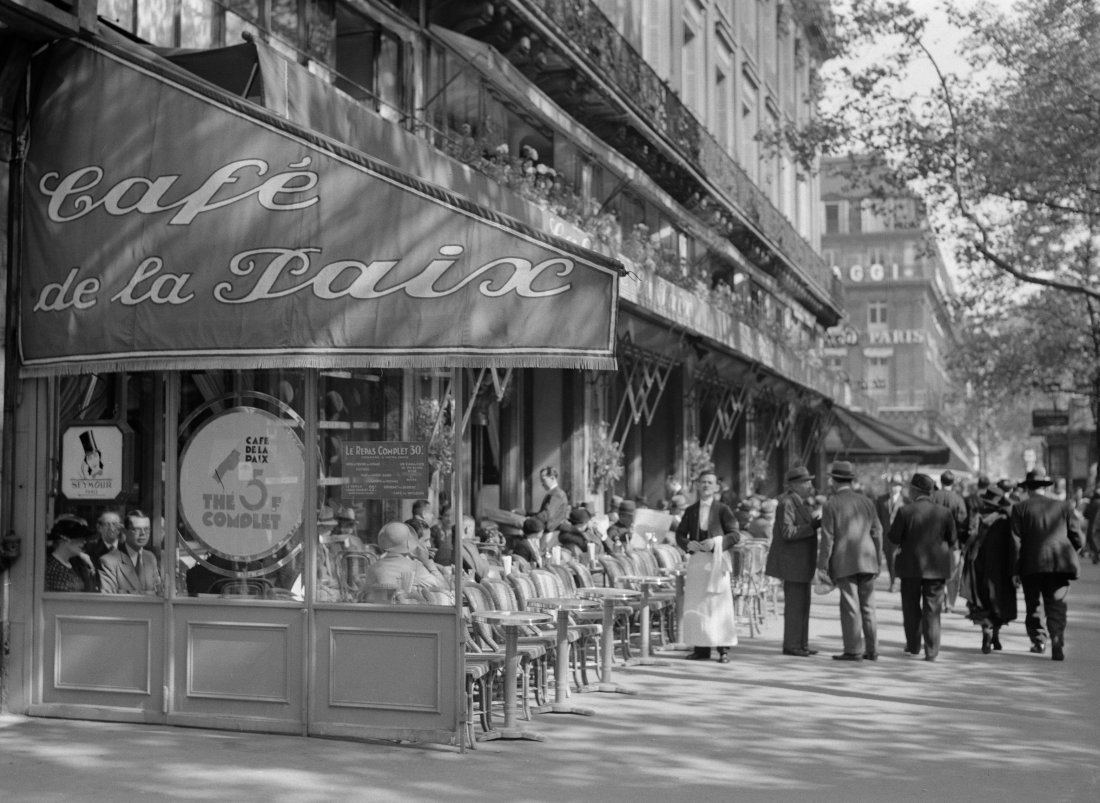
While there were indeed many rounds of embassy parties to host and attend in his French postings, it is more likely that Alfred’s work was fairly boring. Work included the preparation of reports for the Department of Commerce and the Department of State on foreign policies that might impact American economic interests.
One such example is the French tobacco monopoly which was working to eliminate the necessity of buying tobacco abroad. Alfred reported that the monopoly’s plan was to develop tobacco in French “colonies whose soil and climate correspond exactly to colonies of other European powers furnishing high priced tobacco.” This information would be of significant interest to the American tobacco industry which had furnished the French monopoly in 1924 alone with 25,401,000 pounds of light Kentucky tobacco, 737,000 pounds of seed leaf, and 7,183,000 pounds of Maryland tobacco for the manufacture of smoking tobacco.[xxi]
Other equally riveting reports from Alfred were:
- French teasles remained a profitable export crop to the USA. Teasles were used to produce the desirable nap in the manufacture of woolen goods (1924).
- France prohibited import of Dutch hogs due to cholera (1926).
- France enhanced its radio technology to implement a national inter-communication police system (1930).[xxii]
Was This the Beginning of the End?
American Consular Service
Paris, France,
Dec. 9, 1930
Dear Cousin,
I have just learned that we are to leave France sometime in March so as to be at my new post in Africa before May first. The place is Lourenço Marques, in Mozambique, a Portuguese colony in the S.E. coast opposite the southern tip of Madagascar. The town has about 30,000 souls, of which 9,000 more or less white; a Consul General of H.B.M., a Yankee consul (yours truly), a Lloyd’s agent—and I must stop here in order to refrain from copying the whole social register.
Meanwhile, I am having the devil’s own time finding out what ships, if any, ever call at the port, whether the Portuguese quarantine dogs, how high a stove-pipe hat is worn on ceremonial occasions, how well the governor general speaks English, and other questions of like import.
Between us, it is too bad Uncle Sam didn’t send us to Ottawa or Montreal, but that may come later….
Cousin Alfred. [xxiii]
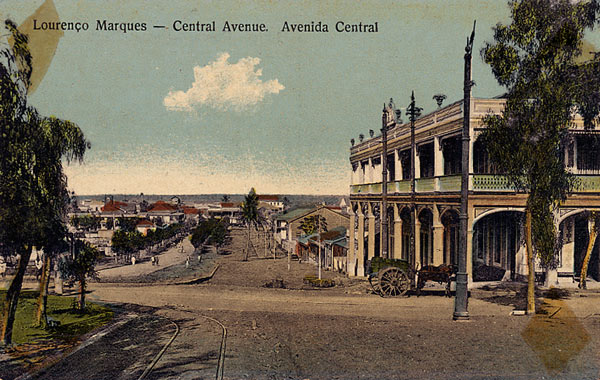
Mozambique was under Portuguese rule from the early sixteenth century. It gained its independence on June 25, 1975 following a lengthy guerilla war waged against the Portuguese government, military, and European settlers.[xxiv]
Between the 1890s and the 1930s, Portuguese rule in Mozambique was characterized by the exploitation of African people and resources by private parties, whether they were foreign company shareholders or colonial bureaucrats and settlers. The most egregious colonial abuses—forced labour, forced crop cultivation, high taxes, low wages, confiscation of the most promising lands—occurred regardless of which group of Europeans was in control…..
The 1926 coup in Portugal created a Portuguese regime that came to be known as the “New State” (Estado Novo). Although most of the former abuses in Mozambique continued and in some cases were intensified, the New State consolidated the profit into fewer hands and promoted conditions that would favour capital accumulation by Portugal and the Portuguese over all others. [xxv]
One example of an issue which likely would have faced Alfred when he arrived in Mozambique was a petition from American missionaries. Portuguese policies put in place by the New State prohibited them from educating the native population in their own language. Moreover, most non-whites were left without access to education.
The Vice-Consul had sent a despatch dated August 14, 1929 to the State Department concerning “legislative enactments in Portuguese East Africa prohibiting the printing of the Bible in the native language and curtailing the use of native dialects.” The Secretary of State responded that there were:
… no treaty provisions in force between the United States and Portugal which have a bearing on the subject under discussion and that it does not appear that the legislation in question is in violation of international law. Therefore, in the absence of evidence of discrimination, there is no basis even for informal representations concerning this subject except the general grounds of comity.[xxvi]
Correspondence between the Vice-Consul and the Secretary of State continued into January of 1930 and the issue does not appear to have been fully resolved as the American missionaries requested. Although the Portuguese Governor General did permit native languages to be used in religious services and books, no concession was made regarding education.
But let’s return to Alfred who had just arrived in Lourenço Marques (now Maputo) in 1930, because it was in Mozambique that Alfred was bitten by a tick. Was this the precipitating factor in his death just six years later? Research on Lyme Disease suggests that, left untreated, it may be a trigger for autoimmune diseases which can destroy the body’s defenses and limit its ability to absorb vitamins such as B12. However, Lyme Disease is caused by Borrelia burgdorferi and Borrelia mayonii, transmitted through the bite of an infected blacklegged tick present in North America and Europe.[xxvii] It is not endemic to Mozambique.
In Mozambique, Alfred more likely encountered Amblyomma ticks infected with Rickettsia africae bacteria which causes African Tick-Bite Fever (ATBF). No mention is made in the literature of a link to autoimmune disease.
Symptoms of African Tick-Bite Fever usually appear within 2 weeks and include fever, headache, rash, muscle pain, and a red sore with a dark centre (known as an eschar) that develops at the site of the bite. ATBF can be treated with antibiotics. [xxviii]
Today, the normal course of treatment for any suspected tick bite would be a course of antibiotics immediately following (or begun even before) official identification of the little beastie. Unfortunately for Alfred, penicillin, which would have greatly helped, was not available to the public until 1945, marking the beginning of the antibiotic era.[xxix] According to Claribel’s letter, the treatment Alfred underwent included “poisons” to counteract the fevers.
Following his consulship in Mozambique, Alfred was posted to Johannesburg and then to Paris. On October 31, 1935 he was posted to London. His final illness[xxx] began in early August 1936 and was diagnosed as pernicious anemia which can be caused by the body’s inability to absorb Vitamin B12. His secondary diagnosis was nephritis, an inflammation of the kidneys, that can be caused by autoimmune disorders. He died in London on October 14, 1936.
I’ll let Claribel conclude our story:
Until now, I never knew what deep grief was like, but I won’t dwell on that too much.
Alfred’s death was a terrible shock as we thought he was improving and apparently he was, according to a long dispatch received from Washington, D.C. mailed to Mother the day before his death. However, the doctors didnt [sic] give him more than six months to live, and during his last days, his greatest desire, amounting almost to an obsession (according to the official dispatch) was to return home to see us again. The department therefore issued an order transferring him to Vancouver B.C.[xxxi] effective when he would be able to travel, routing him through the United States for medical treatment, and hospitalizing him in the government hospital here in Seattle. They felt that the trip home would have a psychologial effect upon him and be of positive curative value, and I’m happy to know he spent his last days in the belief he was coming home.
Our first information was that he would be buried in France but we immediately cabled Cecile he had once requested burial in Arlington Cemetery in Washington, D.C. [Arlington, Virginia]. This you know is the burial grounds of our national heroes. [xxxii]
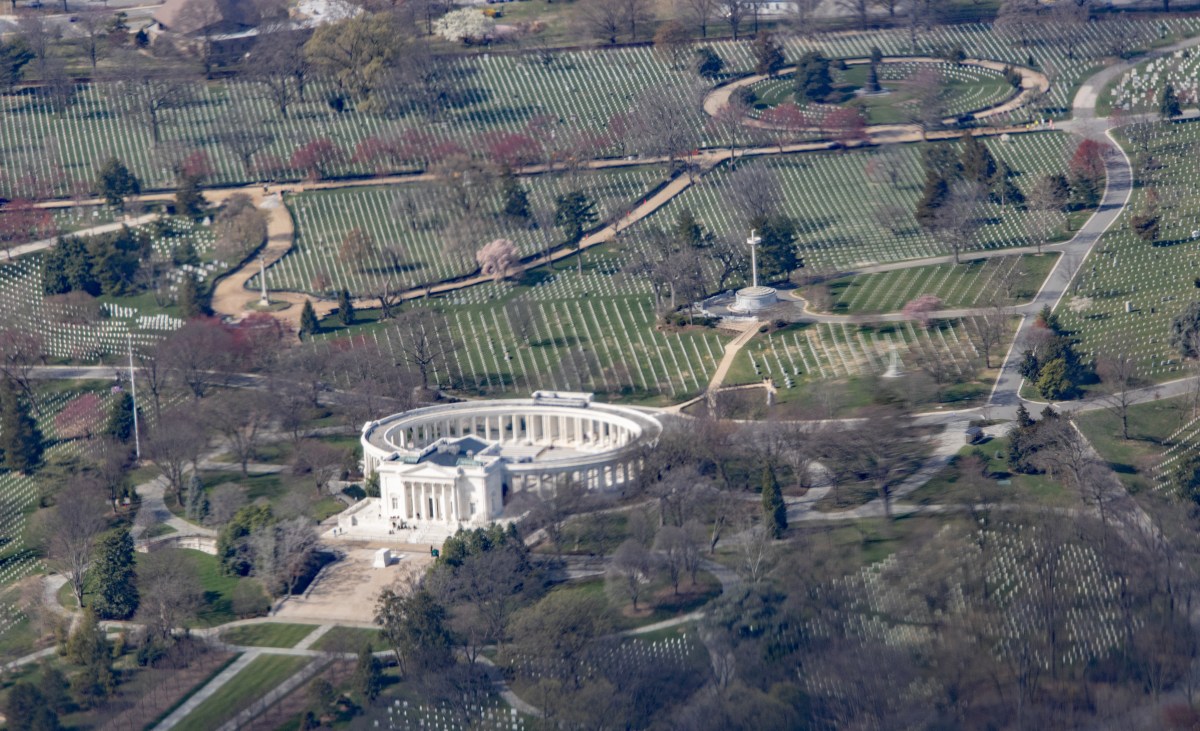
Alfred Dorrance Cameron, Captain, Infantry, U.S. Army, was buried at Arlington National Cemetery on November 12, 1936 (Section 7, Grave Lot 10100).[xxxiii] Cecile later made her home with her sisters-in law and mother-in-law as she had no living relatives. She died in San Francisco on March 29, 1952 and is buried in the same grave as her husband at Arlington.[xxxiv]
[i] Claribel Cameron Beba, letter written to “Aunt Stella” Cameron dated 19 Oct 1936. (Original letter in the possession of Bette Smith.)
[ii] Ancestry.com U.S. Passport Applications 1795-1925, Special Diplomatic Passport Applications, 1916-1925, 1923-1924, Vol. II, Image 264, Alfred D. Cameron, Passport issued 30 Apr 1923. (Ancestry.com ; accessed 29 May 2024.) Alfred’s passport application indicates he and his wife Cecile were travelling to Jamaica and his occupation was listed as “Official”.
[iii] Birth record Register of Births in Seattle, King County, Washington, Record No. 590, p. 32, Alfred Dorrance Cameron. Image Ancestry.com (http://www.ancestry.com ; accessed 29 May 2024) ; citing State Archives; Olympia, Washington; Washington Births, 1891-1919; Film Info: Various county birth registers. Microfilm.)
[iv] 1910 U.S. Census, Seattle Ward 7, King, Washington, Enumeration District 0134 Population Schedule, Family No. 53, 315 Pontius Ave, Cat Z. Cameron with children Alfred D, Edna May and Clara B. Image Ancestry.com (http://www.ancestry.com ; accessed 29 May 2024); citing NARA microfilm Roll T624-1660, p. 2B.
[v] 1910 U.S. Census, Fairbanks, Div 2, Alaska Territory, Enumeration District 0014 Population Schedule, Family No. 213, John A. Cameron Image Ancestry.com (http://www.ancestry.com ; accessed 29 May 2024); citing NARA microfilm Roll T624-1749, p. 9B.
[vi] Seattle Public School District, “Seattle Public Schools, 1862-2000: Cascade School”. HistoryLink.org Essay 10478 posted September 5, 2013.. Source for essay: Nile Thompson and Carolyn J. Marr, Building for Learning: Seattle Public School Histories, 1862-2000 (Seattle: Seattle Public Schools, 2002). (https://www.historylink.org/File/10478 accessed February 13, 2024 and used with permission via Creative Commons License.)
[vii] Paul Dorpat, “Broadway High School, Seattle’s first dedicated high school, opens in 1902.” HistoryLink.org Essay 3204 posted April 15, 2001. (https://www.historylink.org/File/3204 accessed 13 Feb 2024 and used with permission via Creative Commons License.)
[viii] Ancestry.com, “U.S. School Yearbooks 1880-2012” School Name: Broadway High School, Year: 1910, Image 57, Alfred D. Cameron.
[ix] I rather like the maxim included for another student, Frederick Paulding Carrigan: “Thy enemies shall lick the dust”, which was taken from Psalms 72, verse 9 KJV. I don’t have enemies, but if I did, I’d want them to visit when it was time for spring cleaning. Yes, okay, it actually means my enemies will go down to defeat, but I still like my initial interpretation.
[x] Catalogue of the University of Washington for 1913-1914 and Announcements for 1914-1915 (www.washington.edu/students/gencat/archive/GenCat1913-15v1.pdf ; accessed 8 Jun. 2024).
[xi] Ancestry.com, “Washington, U.S., Military Records, 1855-1950”, Washington State Archives; Olympia, Washington; Military Records; Reference: AR82-2-0-9, Image 2046, Cameron, Alfred D. (Ancestry.com ; accessed 8 Jun. 2024.)
[xii] https://en.wikipedia.org/wiki/PanchoVilla
[xiii] D.W. Hoffman, El Paso photographer “General Francisco Villa on horseback”, Gelatin silver photographic postcard, ca 1912, Item 89R46, J. Paul Getty Museum, public domain. (https://commons.wikimedia.org/wiki/File:General_Francisco_Villa.jpg ; accessed 25 May 2024).
[xiv] “I’ve Had About Enough of This”. Uncle Sam leaps across the border fence with Mexico to chase [Pancho] Villa. Cartoon by Clifford K. Berryman, dated 10 Mar 1916, via National Archive Berryman collection, public domain. (https://commons.wikimedia.org/wiki/File:VillaUncleSamBerrymanCartoon.png; accessed 25 May 2024).
[xv] Mitchell Yockelson, “The United States Armed Forces and the Mexican Punitive Expedition: Part 2”, Prologue Magazine, Genealogy Notes,Winter 1997, Vol. 29, No. 4, Pro Prologue, The U.S. National Archives and Records Administration (NARA) (https://www.archives.gov/publications/prologue/1997/winter/mexican-punitive-expedition-2.html ; accessed April 2024).
[xvi] Alexander, Mary and Childress, Marilyn, “The Zimmerman Telegram”, Social Education 45, 4 (April 1981):266. Copy of coded telegram is used with permission of the [U.S.] National Archives which holds the original document.
[xvii] Ibid.
[xviii] Ancestry.com U.S. Passport Applications 1795-1925, Special Diplomatic Passport Applications, 1916-1925, 1923-1924, Vol. II, Image 262, Cecile Eugenie Cameron, Passport issued 30 Apr 1923. (Ancestry.com ; accessed 29 May 2024.)
[xix][xix] Association for Diplomatic Studies and Training, “House Un-American: Foreign-Born Wives of American Diplomats”, 5 Oct. 2015. (https://adst.org/2015/10/house-un-american-foreign-born-wives-of-american-diplomats/ ; accessed 10 May 2024.)
[xx] Ibid.
[xxi] “U.S. Tobacco Buying to be cut by France”, Wilkes-Barre Times Leader, the Evening News, Wilkes-Barre, PA, 8 Sep 1925, p. 9. (Newspapers.com ; accessed 15 Feb 2024.)
[xxii] “Teasles Profitable”, The Philadelphia Inquirer, Philadelphia, PA, Sun., 16 Mar 1924, p 52; “French Prohibit Dutch Hogs because of Cholera”, The Stockman’s Journal, Omaha, NE, Tue. 30 Mar 1926, p. 5; “France Employs Radio Police in National System”, The Burlington Free Press, Burlington, VT, Thu. 7 Aug 1930, p. 15. (Newspapers.com ; accessed 15 Feb 2024.)
[xxiii] Alfred D. Cameron, letter addressed to “Dear Cousin” dated 9 Dec 1930. (Original letter in the possession of Bette Smith.) There is no indication on the letter as to the cousin’s identity. It was included in a collection of family correspondence and newspaper clippings kept by my mother, Mildred Cameron Smith. She was not the cousin, however, as Alfred made reference later in the letter to this person having an infant daughter.
[xxiv] Sheldon, K. Eddy and Penvenne, Jeanne Marie. “Mozambique.” Encyclopedia Britannica, May 26, 2024. (https://www.britannica.com/place/Mozambique.https://www.britannica.com/place/Mozambique/Colonial-Mozambique ; accessed 27 May 2024).
[xxv] Ibid.
[xxvi] Department of State, Office of the Historian, Papers Relating to the Foreign Relations of the United States, 1930, Volume III, 353q116/2, “The Secretary of State to the Vice Consul at Lourenҫo Marques, Mozambique (Stanton), Washington, 8 Nov. 1929.” (https://history.state.gov/historicaldocuments/frus1930v03/d732 Amelioration of legislation affecting American religious missions in Portuguese East Africa, Documents, 732-736 ; accessed 08 Jun 2024.)
[xxvii] Autoimmune Association, “Lyme Disease and the Autoimmune Connection” posted 29 Sep 2022. (https://autoimmune.org/lyme-disease-and-the-autoimmune-connection/ ; accessed 27 May 2024).
[xxviii] Travel Doctor Network, “African Tick-Bite Fever” (https://www.traveldoctor.network/country/mozambique/risk/african-tick-bite-fever/ ; accessed 27 May 2024)
[xxix] Gaynes R. “The Discovery of Penicillin—New Insights After More Than 75 Years of Clinical Use”. Emerg Infect Dis. 2017 May;23(5):849–53. doi: 10.3201/eid2305.161556. PMCID: PMC5403050. (https://www.ncbi.nlm.nih.gov/pmc/articles/PMC5403050/ accessed 27 May 2024).
[xxx] “Alfred Cameron, U.S. Consul Is Dead”, New York Times, New York, NY, 15 Oct 1936, p. 27. (Transcription of newspaper article by D.J. Smith, now in possession of Bette Smith.)
[xxxi] Vancouver newspaper articles indicated that Alfred had been “appointed” as Consul but there was some confusion when no date for his arrival was provided. “New U.S. Consul”, The Vancouver Sun, Tue 13 Oct. 1936. (newspapers.com ; accessed 15 Feb. 2024
[xxxii] Claribel Cameron Beba, Letter to “Aunt Stella”.
[xxxiii] Ancestry.com, “U.S., National Cemetery Interment Control Forms, 1928-1962”, Cameron, Alfred Dorrance (Ancestry.com, image 108 ; accessed 8 Jun. 2024.)
[xxxiv] Ancestry.com, “U.S., National Cemetery Interment Control Forms, 1928-1962”, Cameron, Cecile E, widow of Cameron, Alfred D. (Ancestry.com, image 800 ; accessed 8 Jun. 2024.)
Copyright © Bette Smith 2024

 Tatting the Family Threads...


Fascinating how the geopolitical forces in the USA echo what we observe today with a reluctance to engage in Europe and continuing tension at the border with Mexico. What a fascinating life Alfred led, before succumbing to his mysterious illness…..
Thank you for another stitch in the family tapestry!
LikeLike
Thank you for the information about the damage a tick bite can do, and also the information about Pancho Villa and his troops. Focus when I learned about World War 1 in school focused on the war in Europe, so a great refresher. As always, well written, witty and informative.
LikeLiked by 1 person